

Retro history ·
Retro history, part 3: the crash and the comeback
Part three of our retro series. In 1983 the North American game business nearly vanished. Then a console from Japan and a puzzle from Moscow brought it back.
At the end of part two, arcades were everywhere and home consoles were selling by the million. It looked like the boom would last forever. It did not.
Too many games, not enough good ones
By 1982, the most popular home console in North America was the Atari 2600, released in 1977. Its success attracted dozens of new companies, and anyone could make a cartridge for it. Shops filled up with games, many of them rushed, and players could not tell the good ones from the bad ones on the shelf.
Two famous releases summed up the problem. A home version of Pac-Man looked and sounded far worse than the arcade game everyone loved. And a game based on the film E.T. was built in about five weeks to make it into shops for Christmas 1982. Millions of unsold cartridges ended up back in warehouses.
Some of those E.T. cartridges really were buried in a landfill in Alamogordo, New Mexico. For years people thought it was an urban legend, until a dig in 2014 turned them up.
The crash
In 1983, the North American home video game market collapsed. Over the next two years, sales fell by roughly 97 percent. Companies closed, prices were slashed, and shops cleared their game sections. Many people decided video games had been a fad.
| Year | What happened |
|---|---|
| 1977 | The Atari 2600 launches |
| 1982 | Shelves overflow; the E.T. game misses expectations |
| 1983 | The crash begins in North America. In Japan, Nintendo releases the Famicom |
| 1984 | Alexey Pajitnov writes Tetris in Moscow |
| 1985 | The Nintendo Entertainment System launches in New York |
| 1989 | The Game Boy arrives, with Tetris in the box in North America |
A console from Japan
The crash mostly hit North America. In Japan, Nintendo released the Family Computer, or Famicom, in July 1983, and it was a hit. Bringing it to America was a hard sell, because shops did not want to stock video games at all.
Nintendo’s answer was clever. The American version, the Nintendo Entertainment System, looked more like a video recorder than a game console, and it launched in 1985 alongside a toy robot called R.O.B. to help it get onto toy store shelves. Nintendo also controlled which games could be made for it, with a seal of quality on each box, to avoid the flood of poor cartridges that had sunk the 2600.
Then came Super Mario Bros. in 1985. The little carpenter from Donkey Kong now had a whole scrolling world to run through, and it showed what a home game could do that an arcade game could not: let you explore.
A puzzle from Moscow
At the same time, in 1984, a researcher named Alexey Pajitnov was working at the computing center of the Soviet Academy of Sciences in Moscow. In his spare time he wrote a game where shapes made of four squares fall into a well, and you turn and slide them to complete rows. He called it Tetris.
There was no money in it at first. Copies spread from computer to computer across the Soviet Union and then into Europe. Years of tangled licensing deals followed, and in 1989 Nintendo put Tetris in the box with its new handheld, the Game Boy. It became one of the best-selling games of all time.
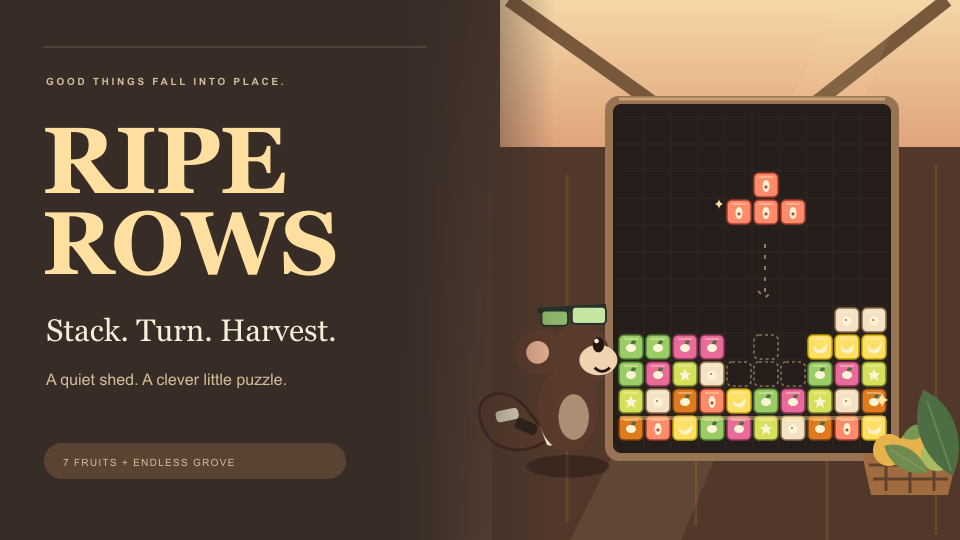
Our own Ripe Rows is part of that family. Fruit crates fall into a well ten wide and twenty tall, and full rows harvest away. The grid size, the next-piece preview and the hold pocket are all ideas the genre built up over the decades after Pajitnov’s first version.
Lessons the industry learned
- Quality matters more than quantity. The crash taught publishers that a flood of weak games could ruin trust in all of them.
- Home games can be bigger than arcade games. Longer adventures, saved progress and worlds to explore became the console’s strength.
- Simple ideas travel. A falling-block puzzle with no story at all crossed borders that almost nothing else could.
Next time in the series: the console wars of the 16-bit era, and how games learned to fit in your pocket.
More from the studio
From the studio /
Take the arcade with you: install it and play offline
Every game in the arcade works without a connection. Here is how to add Cool Monkey Games to your phone or computer, and what happens to your runs and stars while you are offline.
Field guide /
Fizz Lagoon: letters, grottos and beating the tide
Hints and how to play for Fizz Lagoon, from tide timings and the clean-clear bonus to spelling SPLASH, beach pickups, the conch, wave bubbles, grottos and every critter.