

Retro history ·
Retro history, part 2: the golden age of the arcade
Part two of our retro series. The coin slot arrives, and in about ten years arcade makers invent most of the game ideas we still play today.
In part one, games lived on lab computers and one early home console. This time the coin slot arrives. Between 1971 and the early 1980s, arcade makers worked out an astonishing number of the ideas every game designer still borrows, including a few you will recognize from our own arcade.
From a student union to a tavern
In 1971, two coin-operated versions of Spacewar’s idea appeared within months of each other. Galaxy Game was a single machine built at Stanford and installed in the student union. Computer Space, by Nolan Bushnell and Ted Dabney, was the first coin-op video game sold commercially, in a striking fiberglass cabinet. It was hard to learn, and it sold modestly.
Bushnell and Dabney’s next move worked better. They founded Atari in 1972, and engineer Allan Alcorn built Pong: two paddles, one ball, and a single instruction to avoid missing it. The test machine went into a bar in Sunnyvale, California. The often-told story is that it stopped working within days because its coin box was overflowing.
The ideas pile up
Once Pong proved that people would pay to play, the field moved fast. Here are some of the ideas the golden age gave us, and where you can find their descendants in our arcade:
| Year | Arcade idea | In our arcade today |
|---|---|---|
| 1976 | Blockade: steer a line that grows and never cross yourself | Snake in the Garden |
| 1976 | Breakout: a paddle, a ball and a wall of bricks | Coconut Canopy |
| 1979 | Asteroids: drift through space and blast the rocks | Banana Signal |
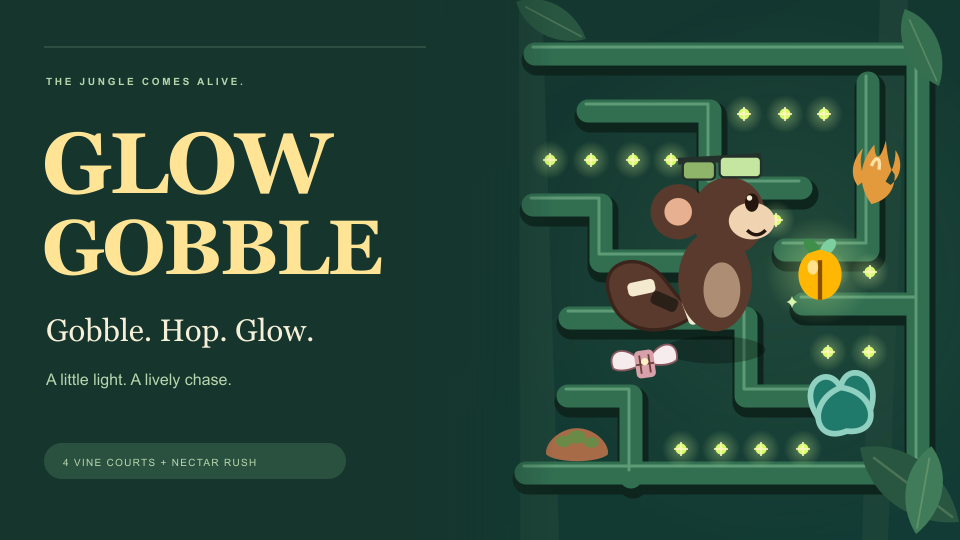
| 1980 | Pac-Man: a maze, dots and four chasers | Glow Gobble |
| 1980 | Missile Command: defend cities from falling fire | Volcano Volley |
| 1981 | Frogger: cross a road, then a river | Lily Leap |
| 1982 | Dig Dug: tunnel underground and pump up the enemies | Banana Burrow |
| 1982 | Q*bert: hop down a pyramid and change every cube | Sunstone Steps |
None of our games copy these. Each one takes a genre that has been around for forty years and builds something new on it. But it is fun to see the family tree.
Why the golden age games felt different
They had to teach you in seconds. An arcade game had no manual and no tutorial. If you did not understand it before your coin ran out, you walked away. That is why so many of them have one clear goal you can read at a glance.
They got harder on purpose. Space Invaders (1978) famously speeds up as you shoot the invaders down, partly because the hardware could draw fewer of them faster. Players loved the tension, and “the game gets faster as you do better” became a rule of the genre.
The high score table made it social. By the end of the 1970s, games were letting players enter their initials next to their score. Suddenly you were not just playing the machine. You were playing everyone else who came to that arcade.
Characters arrived. Pac-Man, designed by Toru Iwatani at Namco, gave its four ghosts different ways of chasing you, so the maze felt alive. A year later, Shigeru Miyamoto’s Donkey Kong introduced a little carpenter called Jumpman, who would soon be renamed Mario.
Our own Glow Gobble spirits each have their own way of hunting too. We will write about them properly on Halloween.
What came next
By 1982, arcades were everywhere, and home consoles were bringing these games into living rooms. It looked like the boom would never end. In part three, it does.
More from the studio
From the studio /
Take the arcade with you: install it and play offline
Every game in the arcade works without a connection. Here is how to add Cool Monkey Games to your phone or computer, and what happens to your runs and stars while you are offline.
Field guide /
Fizz Lagoon: letters, grottos and beating the tide
Hints and how to play for Fizz Lagoon, from tide timings and the clean-clear bonus to spelling SPLASH, beach pickups, the conch, wave bubbles, grottos and every critter.