

Retro history ·
Retro history, part 6: the web and the phone take over
Part six of our retro series. Browser games spread through Flash, phones put an arcade in every pocket, and suddenly anyone could make a game and share it with the world.
In part five, games learned to move in three dimensions, and the simple arcade ideas quietly found new homes on phones and in web browsers. In this part, those new homes take over. By the end of it, you didn’t need a cabinet, a console or a cartridge to play an arcade game. You didn’t even need a publisher to make one.
Games in a browser tab
In 1996, Macromedia released Flash, a tool for putting animation on web pages. It soon learned to run games too, and it was installed on almost every computer that had a web browser. A game made in Flash could be played by anyone, anywhere, with a single click.
| Year | What happened |
|---|---|
| 1995 | Tom Fulp starts Newgrounds, which becomes a home for Flash games and cartoons |
| 1996 | Macromedia releases Flash |
| 2001 | PopCap’s Bejeweled starts life as a free game in the browser |
| 2001 | Miniclip launches and gathers thousands of free browser games |
| 2002 | Bubble Shooter brings the Puzzle Bobble idea to the browser |
Most of these games were made by one or two people, often teenagers working after school. They were short, free and easy to share, and many of them borrowed straight from the arcade: shoot the bubbles, match the gems, dodge the falling blocks.
Why it worked: a browser game asked nothing of you. There was nothing to buy, nothing to install and no disc to find. You clicked a link from a friend and you were playing.
A phone in every pocket
Nokia’s Snake had shown that people would play simple games on a phone. Through the 2000s, phones learned to download games too, but finding and buying them was awkward, and every phone was different.
That changed in July 2008, when Apple opened the App Store for the iPhone. For the first time, a small studio could put a game on millions of phones and sell it for a dollar or two, with a few taps from the player. A wave of quick, touch-first games followed:
| Year | Game | The simple idea at its heart |
|---|---|---|
| 2009 | Doodle Jump | Keep bouncing upward, never fall |
| 2009 | Angry Birds | Aim, fling, and knock it all down |
| 2010 | Fruit Ninja | Swipe to slice whatever flies up |
| 2013 | Flappy Bird | One tap, one gap, one more try |
Look closely and you’ll see the arcade in every one of them: one rule, quick rounds and a high score to beat. Flappy Bird was made by a single developer, Dong Nguyen, in a few days, and it became so popular that he pulled it from the store himself in early 2014.
Anyone can make a game
The other big change was who got to make games. Free tools, cheap game engines and online stores meant a tiny team could reach players directly.
- Game jams like Ludum Dare (from 2002) challenged people to make a whole game in a weekend.
- Indie games such as Braid and World of Goo (both 2008) showed that a game made by one or two people could stand next to the big studios’ work.
- Download stores on PCs and consoles gave small games a shelf of their own.
The end of Flash, and what came next
Flash had a problem: it didn’t run on the iPhone, and in 2010 Steve Jobs explained why in a public letter called “Thoughts on Flash”. Browsers had been learning to draw and animate on their own, with HTML5 and the canvas element, and over the next decade they took Flash’s place. Adobe, which had bought Macromedia, ended Flash for good on 31 December 2020.
Thousands of old Flash games could have vanished that day. Fans and archivists saved many of them, and projects like Flashpoint keep them playable.
What it means for us
Our whole arcade is built on what came out of this era. Every game is made for the browser with HTML5, so there’s nothing to install, and it plays the same on a laptop or a phone. And every game is free to play, for anyone who visits. That’s the browser game promise from the early 2000s, kept: click a link and you’re playing.
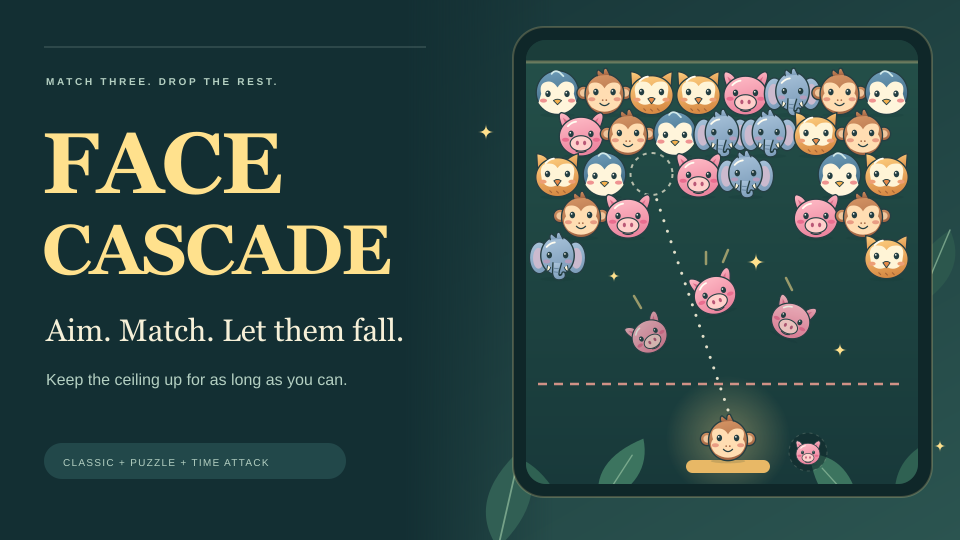
Face Cascade is a direct descendant of those browser bubble shooters, with a few ideas of its own. It’s a good place to see how far that simple idea has travelled.
Next time in the series: how the old arcade came back in style, from retro collections to the games that look old on purpose.
More from the studio
From the studio /
Take the arcade with you: install it and play offline
Every game in the arcade works without a connection. Here is how to add Cool Monkey Games to your phone or computer, and what happens to your runs and stars while you are offline.
Field guide /
Fizz Lagoon: letters, grottos and beating the tide
Hints and how to play for Fizz Lagoon, from tide timings and the clean-clear bonus to spelling SPLASH, beach pickups, the conch, wave bubbles, grottos and every critter.