

Retro history ·
Retro history, part 4: sixteen bits and games in your pocket
Part four of our retro series. Two console makers go to war, the arcade gets a second wind, and a gray brick with an olive-green screen puts games in your pocket.
In part three, the North American game business crashed and then came roaring back on the shoulders of a Japanese console and a Soviet puzzle. By the end of the 1980s, video games were back for good. The question was no longer whether people would play. It was where they would play, and on whose machine.
The 16-bit console war
Nintendo’s NES had a near-monopoly on home games in North America. Sega, a veteran arcade maker, set out to break it with a more powerful machine:
| Year | What happened |
|---|---|
| 1987 | NEC’s PC Engine launches in Japan, later sold in America as the TurboGrafx-16 |
| 1988 | Sega’s Mega Drive launches in Japan |
| 1989 | It arrives in North America as the Sega Genesis |
| 1990 | Nintendo answers with the Super Famicom in Japan |
| 1991 | The Super Nintendo reaches North America, and Sega releases Sonic the Hedgehog |
Sega played the rebel. Its American ads pitched the Genesis as the cooler choice for older players, with lines like “Genesis does what Nintendon’t”. Then, in 1991, it gave the Genesis a mascot built for speed: Sonic the Hedgehog, a blue blur designed to show off a speed Nintendo’s machines couldn’t match.
Nintendo had answers of its own. The Super Nintendo had richer sound and a graphics trick called Mode 7 that could scale and rotate a flat picture, which made tracks in games like Super Mario Kart (1992) seem to stretch away toward the horizon. For most of the early 1990s the two companies fought for every shelf and every birthday list, and players got a golden run of games out of it.
Why “16-bit”? It describes how much data the main processor handles at once. It also became a marketing slogan, so the number on the box got bigger every generation, whether or not it told you much about the games.
The arcade’s second wind
Home consoles were catching up with the arcade, and many arcades were struggling. Then, in 1991, Capcom released Street Fighter II. It had eight fighters, each with special moves you had to learn, and it was built around playing against the person standing next to you. Arcades filled up again with queues of players resting a coin on the cabinet to claim the next game.
Fighting games also brought a new argument. The realistic violence of Mortal Kombat (1992) led to hearings in the US Congress, and in 1994 the industry set up the ESRB to put age ratings on games, which it still does today.
Bubbles, bubbles everywhere
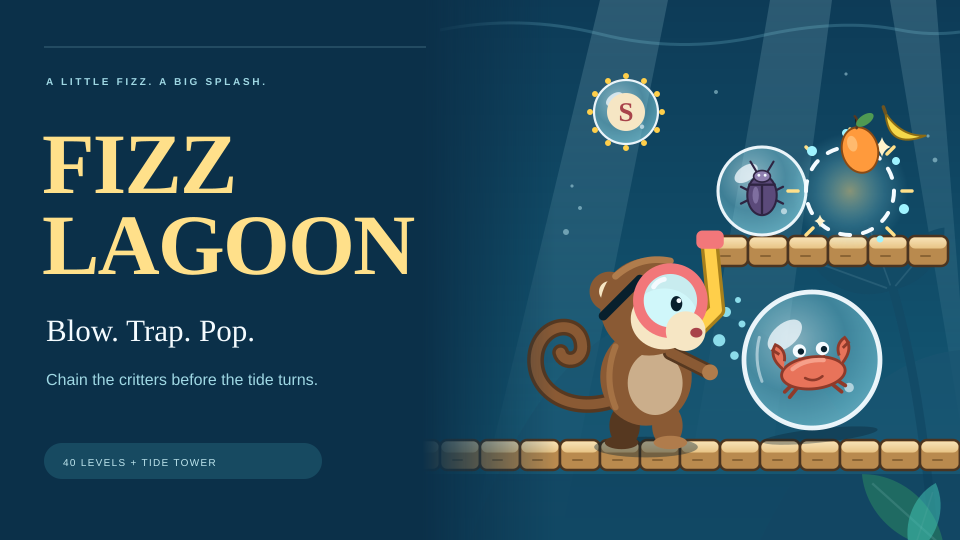
Not every big idea of the era was loud. Taito, the company behind Space Invaders, had a quieter hit in 1986 called Bubble Bobble, in which two little dragons trap enemies in bubbles and pop them for fruit. Eight years later, its spin-off Puzzle Bobble (1994) turned the same bubbles into a shooting puzzle where matching colors burst and everything hanging below them falls.
Both of those ideas have descendants in our arcade:
| Genre | Pioneer | In our arcade today |
|---|---|---|
| Bubble-trapping platform | Bubble Bobble (1986) | Fizz Lagoon |
| Bubble shooter | Puzzle Bobble (1994) | Face Cascade |
| Grid-blast maze | Bomberman (1983) | Boom Grove |
Games in your pocket
Long before the 16-bit war, a Nintendo engineer named Gunpei Yokoi had an idea while watching a commuter play with a pocket calculator. The result was Game & Watch (1980), a line of tiny one-game handhelds with LCD screens. Yokoi’s team also came up with the cross-shaped direction pad for it, which Nintendo then put on almost every controller it made.
In 1989, Yokoi’s team released the Game Boy. On paper it was the weakest handheld of its generation. Its screen was small and had no color, just shades of olive green. Its rivals, the Atari Lynx (1989) and the Sega Game Gear (1990), had bright, backlit color screens.
But the Game Boy had two things they didn’t:
- Battery life. It ran for many hours on four AA batteries, while the color machines went through their batteries far faster.
- Tetris. In North America it came in the box, and it was the perfect game for a few minutes on a bus.
The Game Boy family went on to sell over a hundred million units. In 1996 it got the game that would define its later years: Pokémon, where you trade creatures with friends over a link cable. Yokoi’s philosophy, often summed up as “lateral thinking with withered technology”, is a good lesson for any small studio: you don’t need the most powerful hardware if the idea is right.
What it means for us
Our arcade lives in your browser, and that includes the one in your pocket. Every game we make has touch controls, saves your progress on the device, and since this week the installed app even plays offline. That is the Game Boy promise, updated: a quick game, anywhere, on whatever you have with you.
Next time in the series: the jump to 3D, and how the arcade’s simple ideas survived it.
More from the studio
From the studio /
Take the arcade with you: install it and play offline
Every game in the arcade works without a connection. Here is how to add Cool Monkey Games to your phone or computer, and what happens to your runs and stars while you are offline.
Field guide /
Fizz Lagoon: letters, grottos and beating the tide
Hints and how to play for Fizz Lagoon, from tide timings and the clean-clear bonus to spelling SPLASH, beach pickups, the conch, wave bubbles, grottos and every critter.